Over the last several years, under the leadership of Dean Christopher P. Long and Associate Dean Bill Hart-Davidson, the college made several strategic investments in initiatives designed to increase the visibility and impact of its work in the world. Each of these initiatives has broad-reaching potential not just for the scholars engaged in the projects but for the communities with which they work and the broader social and cultural landscape beyond. Through these initiatives, we hope to transform the very ground on which academic work gets done, creating the possibilities for more generous, more equitable institutions of higher education.
In this Section:
Community-Engaged Scholarship and Creative Practice
The Holocaust and Genocide Teacher Fellowship Program, co-directed by Mary Juzwik (English and Teacher Education) and Laura Yares (Religious Studies), completed the first iteration of a year-long professional development program for teachers of 8-10th grade English Language Arts and Social Studies in public schools in Michigan. The teachers worked collaboratively with MSU faculty and staff to design, implement, and assess new approaches to teaching about the Holocaust and genocide in their K-12 classrooms. A number of scholarly articles connected to this project are currently under review.
The Institute for Ubuntu Thought and Practice (IUTP) launched in July 2023 under the leadership of Upenyu Magee (Philosophy). IUTP works with key communities, including scholars, practitioners, and custodians of community knowledge in supporting the development of an ecosystem of human-centered, thriving communities that are empowered to imagine and shape solutions to the challenges we all face. IUTP held workshops and presentations during the 2024-25 academic year for numerous groups at MSU, across Michigan, and around the world.
The Research Institute for Structural Change (RISC), under the leadership of Elena Ruíz (Philosophy),secured $540,000 in new grants for community health organizations across Michigan, bringing their two-year total to over $2.2 million in community impact. With the support of the College of Arts & Letters, this year RISC launched vital community programs and experiential learning opportunities for students that continue to advance RISC’s mission to strengthen community resilience by supporting place-based, community-led solutions to today’s most pressing structural problems in human health and well-being.
Ruth Nicole Brown (African American and African Studies), through Saving Our Lives Hear Our Truths (SOLHOT), worked with Dr. Gwendolyn Taylor to organize a week-long artist residency and public exhibition for a cohort of 10 Black women artists aged 60 years and older (SOLHOT 60+), in partnership with the Flint Institute of Arts Museum + Art School.
The Womxn of Color Initiatives (WOCI) brought Boston’s Poet Laureate, Porsha Olayiwola, to campus in March 2025 as a part of their annual artist in residence program. Olayiwola engaged in classroom visits, hosted workshops, met with graduate and undergraduate students, and performed a keynote reading of her work. In bringing Olayiwola to campus, the College of Arts & Letters isn’t just hosting a poet—they’re investing in the future of creative arts. By ensuring community access to this artist, contributing to a sustainable pathway for artists, and championing transformative representation in the arts, this is a powerful step toward deepening and diversifying the creative arts ecosystem in the college, MSU, and beyond. (Read more about the Womxn of Color Initiatives’ 2025 Artist-in Residence Porsha Olayiwola.)
Digital Scholarship and Creative Activity
Digital Humanities at MSU (DH@MSU)
Over the last decade, Digital Humanities at MSU (DH@MSU) has functioned both as an academic program, offering an undergraduate minor in Digital Studies in the Arts and Humanities, and as a virtual research center supporting collaborations among faculty, projects, labs, and more exploring our digital present and future. Digital Humanities brings together work using computational methods to study the traditional materials of the arts and humanities with work using the critical methods provided by the arts and humanities to study digital culture.
Among the most publicly visible projects of DH@MSU has been the annual Global Digital Humanities Symposium (GlobalDH), which in 2025 celebrated its 10th anniversary. GlobalDH began as a forum showcasing digital humanities projects at MSU in conversation with external keynote speakers working at the intersections of the digital humanities and global issues. Guided by the team’s values, the event has cultivated a worldwide community of participants that continues to expand each year.
Mesh Research
The College of Arts & Letters has for the last several years collaborated with the MSU Libraries through Mesh Research, a lab exploring tools, platforms, and relationships for the future of digital scholarly communication. Mesh develops and supports a range of tools and initiatives designed to facilitate the digital work that faculty, staff, and students across the university as they conduct and represent their work online. Mesh’s key projects include Knowledge Commons, an open-access, open-source, academy-owned, and scholar-governed network supporting more than 50,000 knowledge creators across the disciplines and around the world. During 2024-25, Knowledge Commons launched its next-generation open-access repository, KCWorks, which is openly available to any interested user, but which additionally provides data and document repository services for the MSU community through MSU Commons. In late 2024, Knowledge Commons contracted with the National Endowment for the Humanities to provide the agency’s officially designated public-access repository (though sadly that contract was terminated in April 2025). The Knowledge Commons team is currently collaborating with MSU’s high-performance computing center, ICER, on the development of the MSU Data Hub, which will support storage, preservation, and discoverability for massive research datasets (funded by the National Science Foundation, grant #2429466, Kathleen Fitzpatrick, co-PI).
Other Mesh Research projects include Pilcrow, a tool for transparent, community-based, developmental peer review; Linked Open Profiles, an open-source plugin for displaying public data from ORCID records on WordPress-based websites (funded through a grant from the ORCID Global Participation Fund, Scott Schopieray, PI).
MI Diaries
The MI Diaries project, led by Betsy Sneller (Linguistics, Languages, and Cultures) and Suzanne Wagner (Linguistics, Languages, and Cultures), has worked since 2020 to document changes in the lives and language of Michiganders – originally in the wake of COVID-19, but quickly branching out beyond those specific concerns – while fostering an inclusive community and a sense of connection in a time where neither are easy to experience. Participants submit periodic audio diaries that allow researchers in the Sociolinguistics Lab to study ongoing changes in regional speech. During 2024-25, MI Diaries added over 200 selected stories to its public archive. Additionally, the MI Diaries team participated in the STEAM Expo Day at the MSU Science Festival on April 5, 2025. Sneller also received a U.S. National Science Foundation grant of $646,385 in 2024 to expand educational opportunities for 6-10th grade students in Michigan and expand research opportunities for undergraduate students at MSU. (Read more about the MI Diaries NSF grant and multi-year project.)
Other Digital Initiatives
MJ Jackson and Sarah Freye collaborated through the Center for Teaching and Learning Innovation and the Instructional Technology & Development team within MSU IT to develop AI Commons, a collaborative hub through which the MSU community can engage with fast-moving questions around the role of generative AI in higher education.
Finally, Rajiv Ranjan (Linguistics, Languages, and Cultures), PI of an ongoing International Research and Studies grant, authored and published several new OER textbooks – Basic Hindi, Basic Tamil (with Vidya Mohan), and Basic Persian (with Nahid Shiran) – and provided pedagogical and technological mentoring to the publication of two new OER textbooks: Intermediate Khmer (by Vathanak Sok) and Advanced Vietnamese(by Tung Hoang). Additionally, Wenying Zhou authored and published the OER Elementary Chinese 1 Workbook.
Charting Pathways of Intellectual Leadership (CPIL)
The CPIL initiative has developed over several years as an initiative of the CAL deans’ team designed to transform university culture by recognizing and rewarding a broader range of academic work. This values-enacted framework shifts scholars’ focus towards high-impact ends of sharing knowledge, expanding opportunities, mentorship, and stewardship to make visible and empower all members of the academic community – from faculty to staff to students – to create meaningful careers that sustain both themselves and the mission of the university.
Senior Associate Dean for Undergraduate Studies and Administration Sonja Fritzsche led a team from the College of Arts & Letters that received a 2024 Delphi Award from the University of Southern California’s Pullias Center for Higher Education for the project “Charting Pathways of Intellectual Leadership: Non-Tenure System Faculty as Full Academic Partners.” The award includes a presentation at AAC&U and a national webinar presentation. The $15,000 award will be put towards the college’s mentoring program. (Read more about CPIL and the 2024 Pullias Center of Higher Education Award.)
The CPIL team has also released the Charting Pathways of Intellectual Leadership Toolbox on Knowledge Commons.
CAL Undergraduate Research and Creative Activity
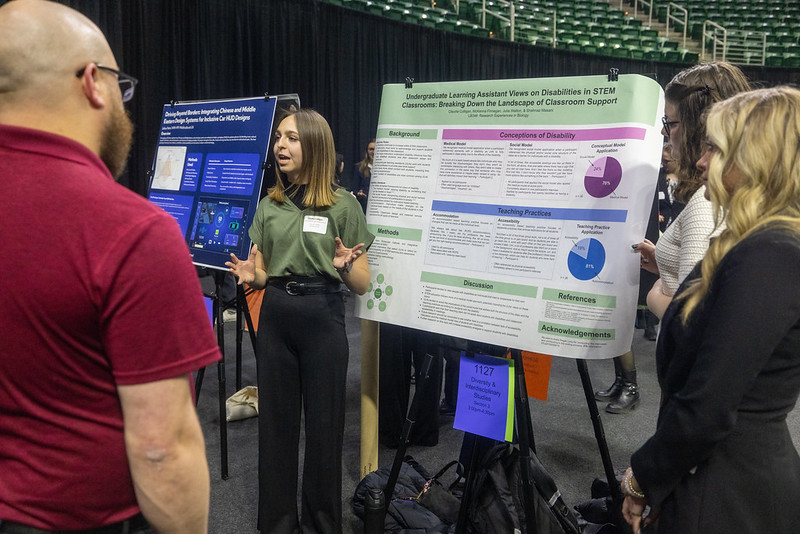
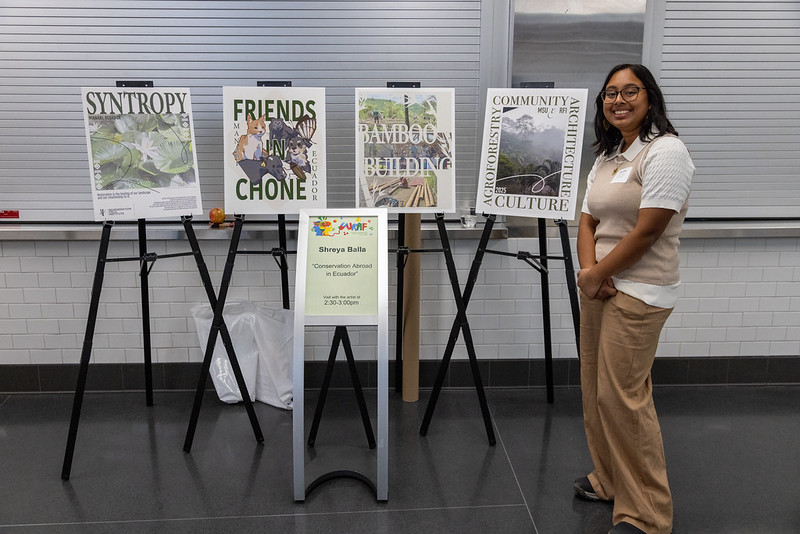
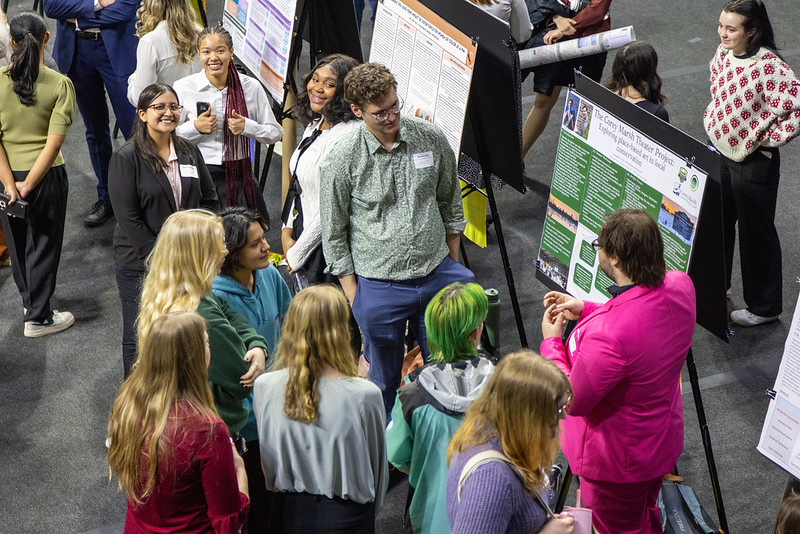
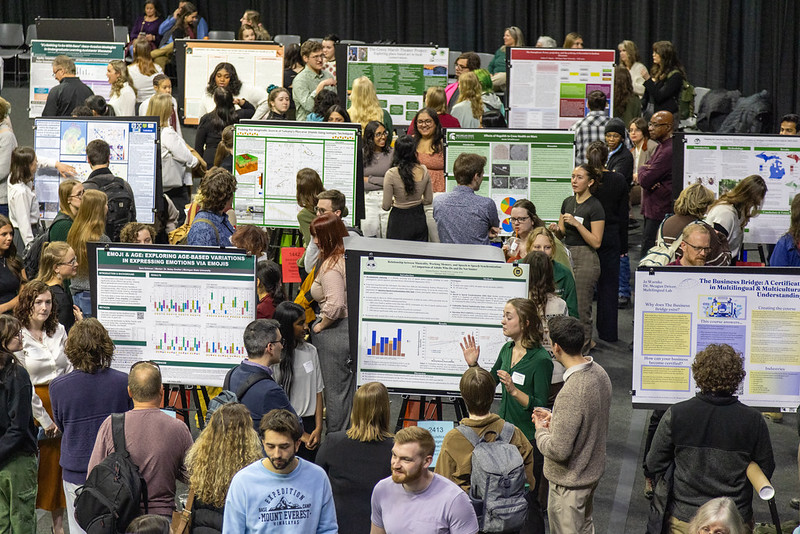
CAL Undergraduate Research and Creative Arts (CAL-URCA), led by Director Deric McNish, supports and celebrates undergraduate student achievements by providing opportunities for innovative research, creative expression, and faculty mentorship. These high-impact experiences help students develop meaningful connections and make significant contributions to their disciplines and communities. This year, CAL-URCA focused on strengthening the college’s culture by building networks, streamlining support for student success, increasing the visibility of undergraduate research and creative arts opportunities, and creating a foundation for growth and recognition across the college.
CAL-URCA’s achievements this year include:
33
CAL-URI Grants
55
CAL Student Presenters at UURAF
8
CAL Students Selected to Present at NCUR
- 33 CAL-URI Grants totaling $32,000, directly supporting faculty-mentored undergraduate research and creative projects across the college.
- 55 CAL student presenters at UURAF (University Undergraduate Research and Arts Forum), earning 9 first-place awards.
- 8 CAL students selected to present at NCUR (National Conference on Undergraduate Research) out of a total of 14 MSU students; NCUR enabled these CAL students to showcase their research and creative excellence on a national stage.