For nearly a decade, composer Austin Oting Har has been building the world of “The Ghost,” a contemporary opera that brings together ancient Greek tragedy, Chinese and Western musical traditions, and experimental electronics. On June 19, that vision finally reached audiences with the release of “The Ghost — Act I: Part I” on Neuma Records and digital streaming platforms, making the work accessible to listeners around the world.
An Assistant Professor in the School of Residential Community-Engaged Arts and Humanities (RCAH) in the College of Arts & Letters at Michigan State University, Har began studying music at age 7. Over the years, he has developed a creative practice that draws equally from composition, language, history, and cultural exchange, blending ancient traditions with contemporary forms into works that move fluidly across cultures and artistic disciplines. He also is the founder of Bogue Street Records in RCAH.

Har began working on “The Ghost” in 2017 while pursuing doctoral studies at the Sydney Conservatorium of Music in Australia. Originally conceived as a symphonic work and narrative poem inspired by Russian composer Alexander Scriabin’s “Poem of Ecstasy,” the project took a new direction when a mentor encouraged him to transform it into an opera.
“That was the first major change in the shape of this project,” Har said. “The spark was the same, the same source of the music and story, but my energy was being channeled into a more appropriate form.”
Over the next several years, Har composed the music and libretto simultaneously while working toward a fully staged premiere in Berlin. But when the COVID-19 pandemic forced the cancellation of performances in both 2020 and 2021, the future of the project became uncertain.
“My experience during this period was of sadness, anger, and envy over my unrealized work. Then guilt over feeling those feelings knowing that many others had it worse,” Har said. “Over time, it settled into a mixture of sadness and gratitude.”

Rather than letting the opera remain unfinished, Har reimagined it as a recorded work. What he calls the opera’s “second lifetime” involved years of recording, editing, and recomposition. Much of the project was recorded under pandemic restrictions in a converted storage unit in western Sydney, where collaborators worked in small groups to bring the music to life.
“Returning to ‘The Ghost’ afterwards, I was able to approach it with amor fati,” Har said, “embracing all the ups and downs, loving it as my path, and appreciating this work as both a duty and a privilege.”
“My journey has been inherently multicultural and interdisciplinary. I am comfortable in liminal spaces and curious about the interconnections between different cultures.”
That process of adaptation mirrors the opera itself, which explores transformation on both personal and collective levels. Drawing from his experiences across classical music, ancient Greek philosophy, traditional Chinese music, and Berlin’s experimental arts scene, Har created a work that moves fluidly between cultures while remaining grounded in a cohesive artistic vision.
“My journey has been inherently multicultural and interdisciplinary,” he said. “I am comfortable in liminal spaces and curious about the interconnections between different cultures.”
These influences appear throughout the opera. Performed in Attic and Doric Greek alongside an invented language from the mythological city-state of Sélvehm, “The Ghost” combines historically informed elements with speculative worldbuilding inspired by writers such as Ursula K. Le Guin and the Afrofuturist mythology of Detroit techno duo Drexciya.
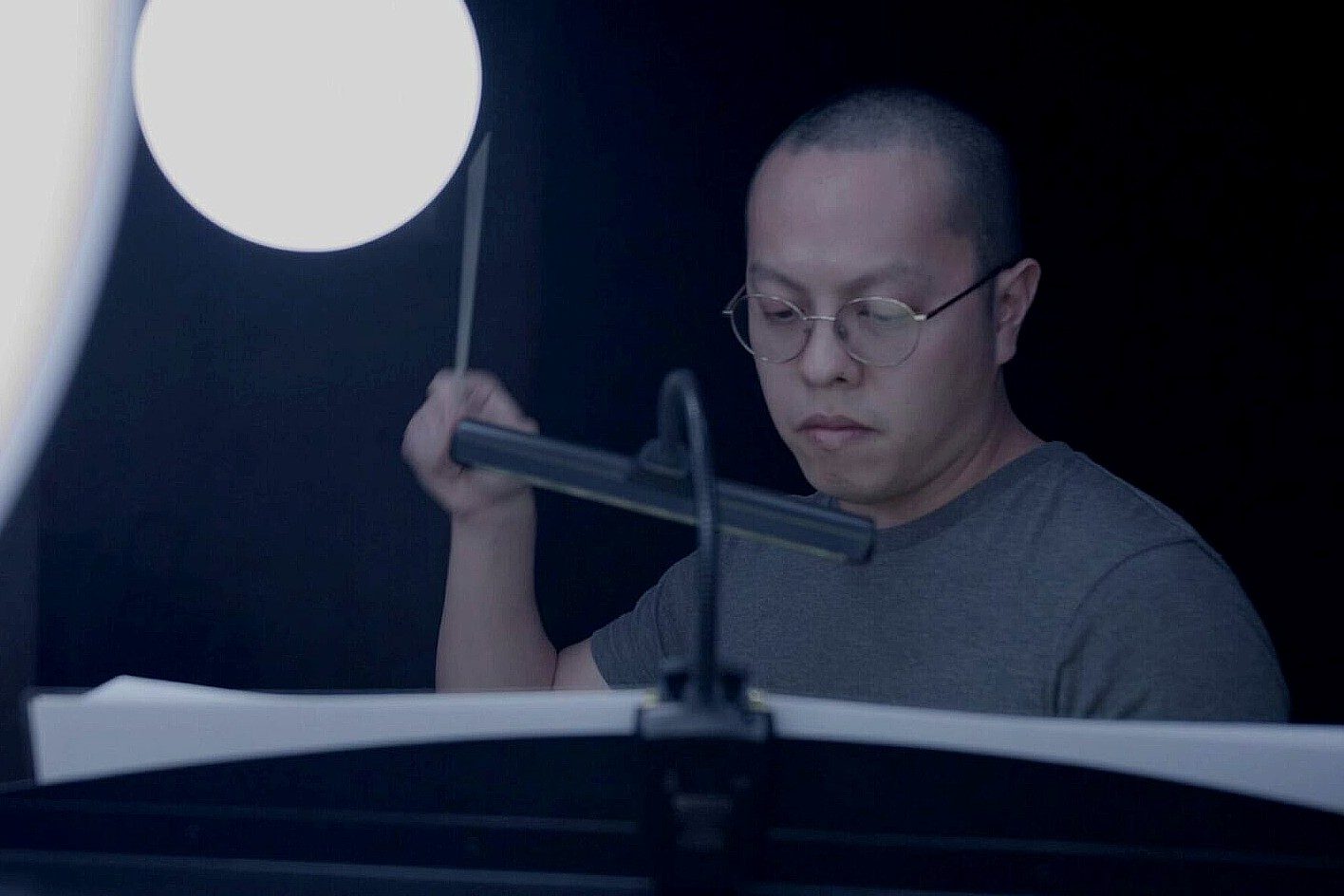
At its core, however, the opera asks questions about masculinity, identity, and self-understanding. Har describes the work as a psychodrama of masculinity and the ego ideal, informed by both his personal experiences and broader cultural conversations.
“What does it mean to be a decent Asian-Australian/Asian-American man today?” Har asks in the opera. “What does healthy masculinity look like today? What positive frames of reference can young men at large, from wide-ranging backgrounds, have today?”
“I hope audiences read the libretto, listen to the tracks in order, and experience more of the story.”
Through the story of Olova, a tragic hero who confronts his shadow, Har explores themes of vulnerability, transformation, and wholeness. Drawing on Daoist philosophy, Zen spirituality, and Jungian psychology, the opera suggests that growth comes not from rejecting parts of ourselves, but from learning to integrate them.
After years of cancellations, revisions, and reinvention, “The Ghost — Act I: Part I” represents both the culmination of a long creative journey and the beginning of a new chapter. For Har, the release is less an ending than an invitation into a world he has spent nearly a decade creating.
“I hope audiences read the libretto, listen to the tracks in order, and experience more of the story,” he said. “I hope others have similar experiences.”
Learn more about Austin Oting Har’s work:
- “The Ghost – Act I: Part I“
- “The Ghost – Act I: Part I” Free Booklet
- Austin Oting Har’s website
- Article on Bogue Street Records
- More On Bogue Street Records
By Jess Watley ’27, RCAH Senior Communications Intern


