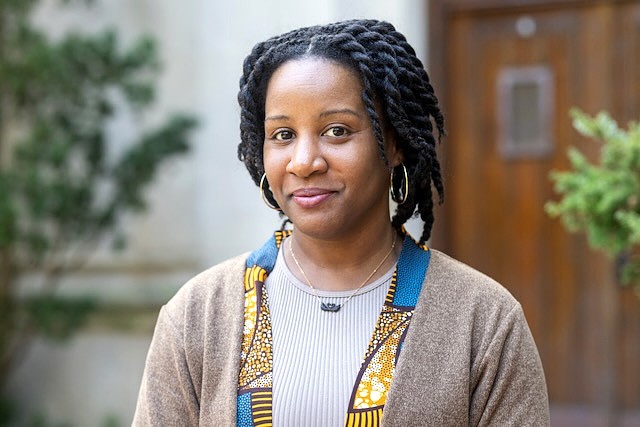
Kaylin Casper, a graduating senior whose advocacy for Indigenous rights and equitable education has shaped her time at MSU, closes her undergraduate career with two of the university’s most distinguished student honors, three majors, and two Bachelor of Arts degrees.
Casper graduated in Spring 2026 with a B.A. in Sociology through the College of Social Science and a B.A. in Humanities-Prelaw with an additional major in Women’s and Gender Studies, both through the College Arts & Letters, as well as a minor in American Indian and Indigenous Studies, also through the College of Arts & Letters. She also was an Honors College student.

She is the 2026 recipient of the Richard Lee Featherstone Endowed Prize, awarded annually to the most outstanding graduating senior at Michigan State University for intellectual ingenuity, creative thinking, and exceptional character in enriching the lives of others. She also has been named the College of Arts & Letters’ Outstanding Senior Achievement Award winner, the college’s highest student honor, recognizing academic excellence, service and leadership, and a sustained commitment to personal and professional development.

“I’m incredibly honored,” Casper said of the Featherstone recognition. “I was up against some amazing people. Some of them were my friends, so I know that they are super incredible. I feel really honored to be named for that distinction.”
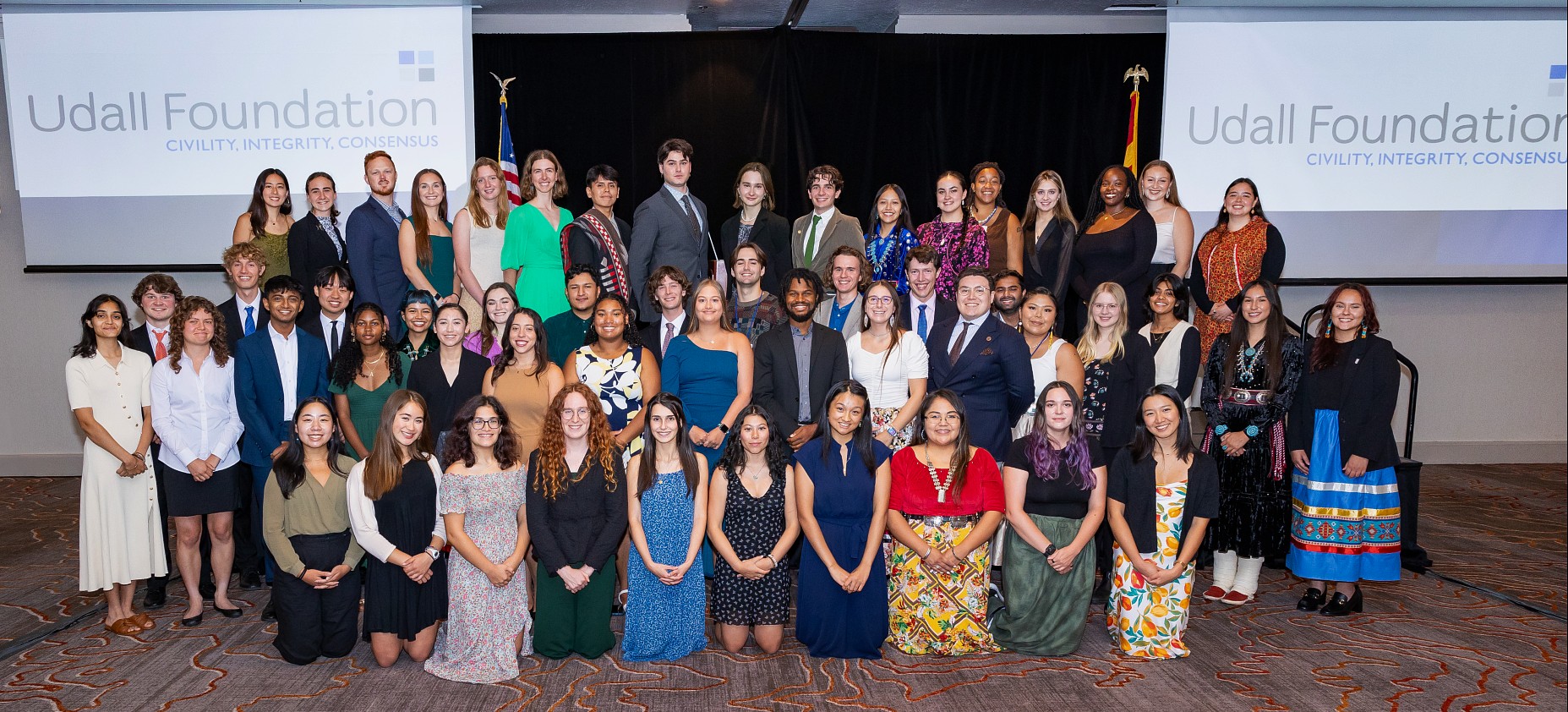
The dual recognition caps an undergraduate experience filled with national distinction. In 2024, Casper was awarded the Udall Undergraduate Scholarship to become Michigan State University’s 14th Udall Scholar. This nationally competitive scholarship identifies future leaders in environmental, Tribal public policy, and health care fields and honors the legacies of Morris K. Udall and Stewart L. Udall, whose careers had a significant impact on Native American self-governance, health care, and the stewardship of public lands and natural resources.
Casper is Anishinaabe and a direct descendant of the Grand Traverse Band of Ottawa and Chippewa Indians. She was awarded the Udall Undergraduate Scholarship for her work in tribal policy.
Casper served as Co‑President of the North American Indigenous Student Organization for the 2025-2026 academic year, conducted original research on Indigenous rights litigation in the U.S. Supreme Court, was a member of the Social Science Scholars Program, a representative in the Associated Students of Michigan State University (ASMSU), and worked in MSU’s Writing Center for more than three years.
She was named a Rhodes Scholarship national finalist — one of only 238 students out of nearly 2,800 applicants nationwide — a Truman Scholarship finalist, and a Marshall Scholarship nominee. She also served on MSU’s 2025 Homecoming Court and was a third-place finisher in 2025 for the Honors Giving Back Award.
Roots and Reconnection
Casper moved from Burbank, California, to East Lansing, Michigan, in part to reconnect with her Anishinaabeg tribal community.
“I think it was gradual self-discovery and reclaiming culture,” she said. “First, I had to get over my fears of feeling like I didn’t belong because I was mixed. The predominately white spaces I was in didn’t fully understand my worldviews or experiences, and I’m not Native enough for the Native spaces. Growing up, I had a lot of people tell me I’m not Native, I’m not this, I’m not that, trying to define who I was for me. So, when I came to college, I really had to intentionally assert my identity and educate people along the way that being Indigenous is not a look. To me, being Indigenous is having a community and having that community claim you in return.”

When Casper first arrived at MSU, she reached out to the North American Indigenous Student Organization (NAISO). She also attended powwows and cultural workshops, visited elders at the Nokomis Center in Okemos, and attended a round dance in Northern Michigan with her grandmother, all experiences that helped Casper find her community.
“You really do learn the most from the friendships and the connections,” she said. “Within those, there’s spaces for cultural sharing.”
Humanities: a Tool of Resistance
Casper’s decision to pursue Humanities-Prelaw rather than a more conventional prelaw track grew out of her views on the relationship between law, history, and Native nations.
“I am really interested in the ways in which law can be used as a tool of resistance for Native Americans navigating U.S. legal systems,” she said. “Historically and still today, law is used as a tool of harm. That is particularly true when you look at the history of Native nations in the United States. Even when I think about MSU, and how MSU got its land through the Morrill Land Grant Acts, which forcefully dispossessed 10.7 million acres of land from over 245 Native nations.”

Casper sees that legal knowledge as a path into a particular kind of work
“Going into this next era of tribal self-determination, I’m really interested in pursuing a career that employs law as a tool of social justice and sovereignty for Native nations,” she said. “The cross between humanities and law fit really well within that interest. So, Humanities-Prelaw was pretty much a perfect major for me.”

That path was broadened in Summer 2025, when Casper took part in a College of Arts & Letters-supported study abroad program in Amsterdam led by Pat Arnold, an Academic Advisor in the Center for Gender in Global Context who works with Women’s and Gender Studies and LGBTQ+ Studies. The program focused on sexual orientation, gender identity, and sexual politics, and Casper has called it one of the most formative experiences of her undergraduate career.
“One of the books we read was Decolonial Feminism, which really changed the way I saw my work,” Casper said. “As someone who focuses on Indigenous rights in the United States, it’s easy to be domestic in scope because it feels so large. There are 575 federally recognized tribes. The Amsterdam study abroad really opened my understanding of colonialism transnationally — that the fight for Indigenous justice is inherently global, and these problems are happening everywhere.”
Arnold, she said, has been one of her most important mentors at MSU— “the most caring, compassionate person.”
Building Something That Lasts
When asked what she is most proud of from her time at MSU, Casper points to three concrete achievements that will outlast her undergraduate years.
The first is the establishment of Native student housing on campus. Pilot programming is set to begin in Fall 2026, with the first full year of the living-learning community to follow in Fall 2027.

“There are fewer than 130 Native undergraduate students here,” Casper said. “I’m really glad that this could be a space where we can make being a Native youth in higher education more culturally and socially accessible to Native students who have distinct needs.”
The second achievement is a campus-wide protest she organized earlier this year in support of immigrant justice.
“I was the lead organizer for that, and over 1,000 students came out, with over 18 student organizations involved; NAISO was one of them,” Casper said. “We were in below-freezing temperatures to make our voices heard. It was the largest protest at MSU in my time here.”

The third achievement is the new MSU Land Acknowledgement, passed by the Board of Trustees in Fall 2025 — the result of six years of advocacy by Native students, including Casper, as well as faculty and the broader Indigenous community at MSU.
“It was written by and for Native students, faculty, the greater Indigenous community,” Casper said. “It has a call to hold MSU accountable to Native students.”
An Anishinaabemowin translation, prepared by a community member, will appear alongside the English text on three physical plaques to be installed on campus — one in People’s Park, where Native peoples were still living when MSU was founded, and two at the Multicultural Center.
“As an Anishinaabe student, I wanted our presence on campus to be visible,” Casper said. “I wanted to carve out spaces for Indigenous joy and Indigenous histories and futures.”
Looking Ahead
After graduation, Casper plans to take a gap year before pursuing a dual JD/Ph.D. in Sociology focused on federal Indian law.
“I really want to blend theory and action,” she said. “I don’t think theory should be something that’s relegated to academia, taught, and then not utilized within society. I am on a mission to make the knowledge useful. Academia produces it — that’s the sociology — and the practical, actionable part is the JD. I want to make more informed public policy that is attentive to the needs of Indigenous folks.”

Casper hopes to begin her career in nonprofit legal work with organizations like the Native American Rights Fund or Survival International, a global Indigenous rights group before transitioning to federal work in the Office of Tribal Justice within the U.S. Department of Justice. She also imagines, on a more personal side, a future that includes a cozy book-filled cottage and a few rescued senior dogs.
When asked what advice she would give her freshman self, Casper reflected on the moments in between work and achievement.
“Finding yourself and exploring who you are is just as important as the academics in college,” she said. “There was always a drive to be productive, you’re really busy, let’s get stuff done. But the in-between moments are just as meaningful, and I learned maybe even more from them about myself, my strength, my resilience, and who I am.”