Ashley Romo came to Michigan State University with dreams of becoming an actor. But shortly after arriving on campus, the Detroit native discovered that her passion for theatre extended far beyond performing on stage.
Now a senior in MSU’s College of Arts & Letters, Romo is a first-generation college student and the daughter of Mexican immigrants who is pursuing a double major in Theatre and Philosophy. Through her interdisciplinary education, she has discovered new ways to combine her interests in storytelling, research, cultural identity, and philosophical inquiry.

As MSU celebrates First-Generation Week, Nov. 2-6, Romo’s story highlights the experiences, accomplishments, and aspirations of students who are the first in their families to attend college.
A graduate of Western International High School in Detroit, Romo has embraced opportunities to explore her diverse interests while forging an academic path of her own. A painter, dramaturg, budding philosopher, and bilingual student, she is finding meaningful connections across disciplines while hoping to inspire others to pursue their interests, even when those paths are unconventional.
As a first-generation student and Latina pursuing a field in which she sees relatively few people with similar backgrounds, Romo recognizes the importance of representation and mentorship. She hopes her experiences will encourage others to explore academic opportunities they may not have previously considered.
“I don’t see a lot of Latinas in my field,” Romo said. “Being first-generation, it’s very hard sometimes. And the fact that I’m creating this pathway, which is unusual, because a lot of Latinos do not go into philosophy, or the humanities in general, I think it’s going to be very interesting to go through that path and help someone else in it.”
“There were a lot of moments I was lost, especially being first-generation. I dealt with imposter syndrome, and I still deal with it. It’s very prominent a lot of times, but it also has given me a sense of drive and motivation.”
Romo has also embraced opportunities to engage with and represent the Latino student community beyond the classroom. She was among a group of Latino student leaders at MSU selected to attend the United States Hispanic Leadership (USHLI) Conference in Chicago in February 2026 on behalf of Culturas de las Razas Unidas.
While Romo has embraced these opportunities, navigating college as a first-generation student has sometimes brought feelings of uncertainty and self-doubt. But those challenges also have strengthened her determination to pursue her interests and make the most of her opportunities.

“There were a lot of moments I was lost, especially being first-generation,” she said. “I dealt with imposter syndrome, and I still deal with it. It’s very prominent a lot of times, but it also has given me a sense of drive and motivation.”
Throughout her journey, Romo has drawn strength from her family and the faculty mentors who have encouraged her to explore her interests and pursue new ideas.
“Not only am I doing this for myself, but I also have the biggest support system,” she said. “Without that support system, I wouldn’t be here.”
Romo credits her faculty mentors at MSU with helping her develop the confidence to pursue her ideas and discover connections among her academic interests. Their encouragement has been instrumental in transforming her curiosity into meaningful research opportunities.
“At MSU, I can go up to a professor with an idea for a research project, even if it seems far-fetched, and not only will a faculty member listen, they will do their best to help me flesh out that idea so that it is something worth digging deeper into,” Romo said. “And then they encourage me as I explore more and more.”
That support has helped Romo build an academic experience that reflects her interests, background, and ambitions while preparing her to open doors for others who hope to follow a similar path.
Finding Her Path

Romo had little formal theatre experience before college. During her first year at MSU, she tried her hand at acting but soon realized her passion lay in the intellectual and research-driven work that takes place behind the scenes.
At the same time, a philosophy course rekindled an interest she had been developing since high school, when a history teacher introduced her to the writings of Voltaire. Inspired by the course, Romo decided to add Philosophy as a second major alongside Theatre.
“Both majors made me challenge how to think critically, how to articulate better, and also how to tell stories a lot more effectively,” Romo said. “A lot of people think that in theater it’s just, ‘Oh, you’re going to act.’ No, there’s so much that goes into theater — research, directing, writing. The greatest thing is that you can apply those tools in philosophy, in history, in studio art, any other major.”
“Both majors made me challenge how to think critically, how to articulate better, and also how to tell stories a lot more effectively.”
Studying both disciplines has strengthened Romo’s ability to analyze complex ideas, ask thoughtful questions, and approach storytelling from multiple perspectives.
Her creative interests also extend beyond the classroom and stage and began at an early age.

“I was born with a brush,” said Romo, a visual artist who has gained recognition for her paintings, including a Scholastic Silver Key Portfolio Award, and has exhibited her work at the Detroit Institute of Arts, Fox Theatre, and Boomer Gallery in London. Her first solo exhibition took place at the Royal Oak Public Library in February 2026 as the Royal Oak Arts Council’s Artist of the Month.
Romo also works as a live event artist, creating portraits of people in as little as five minutes.
Discovering Dramaturgy
Through MSU’s Department of Theatre, Romo discovered dramaturgy, a field that combines research, analysis, and storytelling to provide historical, cultural, and literary context for theatrical productions. The role of a dramaturg, who works closely with directors, actors, and production teams, proved to be a natural fit for her academic interests.
“I was craving more on the intellectual, academic side,” Romo said. “And then I found out about dramaturgy.”
Romo is currently serving as assistant director and dramaturg for the Department of Theatre’s production of “Antigone,” which runs Nov. 6-15, 2026, at the Pasant Theatre in Wharton Center for Performing Arts. The production marks her first experience as an assistant director, allowing her to apply skills developed through her previous work in acting, theatrical design, and dramaturgy.
“This is my first assistant directing role ever,” Romo said. “At first, I was quite scared, but I’ve always wanted to be part of a directing role. Because I’ve had experience doing acting, design, and dramaturgy, it was wonderful to see that I could use those skills and be informed of how those processes are alike. So then I could help assist not only the director but everyone in the cast.”
“I was craving more on the intellectual, academic side, And then I found out about dramaturgy.”
She previously served as dramaturg for the Department of Theatre’s Fall 2025 production of Shakespeare’s “Othello” and its spring 2026 production of “Jane Austen’s Persuasion.”
Her responsibilities as dramaturg include researching the historical and cultural contexts of each play, examining language and themes, collaborating with directors and production teams, and developing educational materials to help actors and audiences better understand the stories being told.

Working on “Jane Austen’s Persuasion,” an adaptation of a novel Romo particularly enjoys, provided an opportunity to bring together her interests in theatre, literature, and philosophy.
“All these moments that I was building up for in my personal life just came together beautifully in that project,” Romo said. “’Persuasion’ is a story about regret and the power of love and human connection, the influence of socio-economic internal factors, family values, and how they could get in the way of connection.”
Romo’s philosophy coursework has further strengthened her approach to dramaturgy, teaching her to ask precise questions, communicate ideas clearly, and remain open to different interpretations. These skills have proven especially valuable when collaborating with directors, actors, and other members of a production team.
Exploring Cultural Identity Through the Zoot Suit
Romo’s interdisciplinary interests also inspired an undergraduate research project that brought together her studies in Theatre and Philosophy with her interest in Chicano culture.
Her paper, “A Philosophical Study of the Zoot Suit in Chicano Culture,” examines how clothing can become a powerful symbol of cultural identity, political resistance, and collective memory.

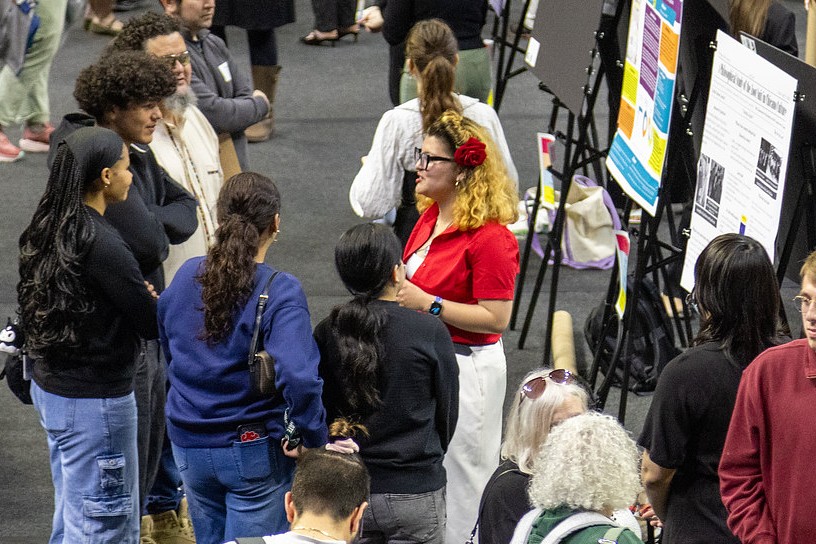

“Fashion is often treated as an aesthetic choice or personal accessory, yet clothing can function as a powerful medium of social meaning,” Romo wrote in her research abstract.
Working with Dan Smith, Associate Professor in the Department of Theatre, and John Grey, Teaching Specialist in the Department of Philosophy, Romo explored the cultural significance of the zoot suit, a distinctive style of clothing that became closely associated with Mexican American youth culture during the 1940s.
“One of the greatest things about research projects is that it’s always evolving. You just get to find new information and argue and just present your own conversation.”
Her research examines how the garment evolved into a symbol of identity and resistance, particularly during a period of discrimination against Mexican Americans and the 1943 Zoot Suit Riots in Los Angeles.
Drawing on philosophical analysis and her experience in dramaturgy, Romo also studied how the play “Zoot Suit” portrays the garment’s cultural significance and demonstrates how clothing can represent more than personal style.

“I think there’s something really interesting about identity and the attachment of an object to an identity,” Romo said.
Romo presented her research at MSU’s 2026 University Undergraduate Research and Arts Forum (UURAF) where she earned second place in the Humanities Poster Presentation, Section 1.
“One of the greatest things about research projects is that it’s always evolving,” Romo said. “You just get to find new information and argue and just present your own conversation.”
Looking Ahead
As she prepares to graduate in May 2027, Romo is applying to graduate programs in philosophy, with the long-term goal of earning a Ph.D. and becoming a professor. She hopes to teach internationally, potentially in Mexico, while continuing to pursue her interests in theatre and visual art.
“There were times when I felt like I wasn’t good enough and that I don’t deserve to be here. I had to tell myself, you have something to say, and you also have something to express. Do it.”
Reflecting on her experiences at MSU, Romo hopes other students, particularly those who are first-generation or come from underrepresented backgrounds, will have the confidence to pursue their own interests and recognize the value of their perspectives.
“There were times when I felt like I wasn’t good enough and that I don’t deserve to be here,” Romo said. “I had to tell myself, you have something to say, and you also have something to express. Do it.”
By Austin Curtis and Kim Popiolek


