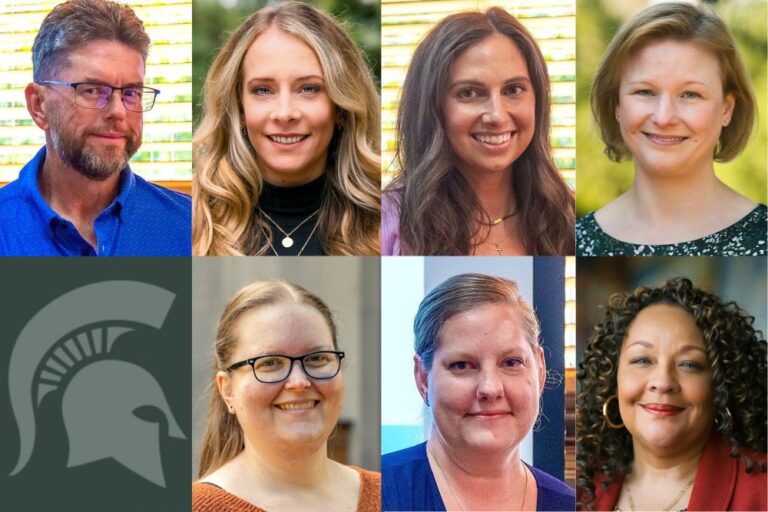
A citizen of the Navajo Nation and an acclaimed poet, artist, and educator, Esther Belin joined Michigan State University this fall as the new Audrey and John Leslie Endowed Chair in North American Indian and Indigenous Literary Studies in the Department of English. She is the second scholar to hold this position, following Gordon Henry, who retired in 2023 after serving as the inaugural Leslie Chair.
“We are absolutely delighted to have an accomplished poet and artist like Professor Belin join our Creative Writing Program. Professor Belin’s work reflects a career-long dedication to the poetics of Native languages and literature, and an inspiring commitment to tribal communities,” said Justus Nieland, Chairperson of the Department of English. “Professor Belin’s creative practice and teaching will inspire our students to think more deeply about the entwined histories of language and land.”

The main purpose of the Audrey and John Leslie Endowed Chair in North American Indian and Indigenous Literary Studies is to promote the transformative potential of literature.
“It is a great honor. It is a great opportunity,” Belin said of being named to this position. “I’m being very intentional with what that means — getting acquainted and involved in the culture of the institution and my department. Where do ideas converge? What can I build with the resources and partnerships at MSU?”
“Professor Belin’s work reflects a career-long dedication to the poetics of native languages and literature, and an inspiring commitment to tribal communities.”
Justus Nieland, Chairperson of the Department of English
Belin brings to MSU a distinguished record of creative and scholarly work. She joined MSU in August from Fort Lewis College in Colorado where she taught in the Native American and Indigenous Studies Department and developed a Diné Poetics course that highlights Indigenous sound and language.
“Having Professor Belin on campus this semester has already been incredibly impactful,” said Kristin Arola, Director of MSU’s American Indian and Indigenous Studies Program. “With so few Native faculty at MSU, her presence means a great deal to our community. She’s a consistent and inspiring presence at both campus and community events — showing up for students, engaging with colleagues, and contributing her energy and insight in ways that matter deeply.”

Kevin Leonard, Director of the Native American Institute, echoed that sentiment.
“With the addition of Professor Belin,” he said, “MSU gains not only a gifted writer, storyteller, and poet, but also a dedicated faculty member whose deep commitment to Indigenous communities and student success — both undergraduate and graduate — will enrich our academic and cultural landscape.”
Belin’s vision for the Leslie Chair is grounded in accountability to her home community. She calls the region just east of Dibé Ntsaa, also known as Hesperus Mountain, in southern Colorado, the northern boundary mountain of Dinétah, her home.
“Having Professor Belin on campus this semester has already been incredibly impactful. With so few Native faculty at MSU, her presence means a great deal to our community.”
Kristin Arola, Director of MSU’s American Indian and Indigenous Studies Program
“To honor the history of my family, I need to make sure whatever I create academically, whatever scholarship I’m doing, I am able to present it to my community and they’re able to understand it,” she said. “I want to be the type of person who can talk in these conversations with academia and then go back to my community and I can speak my tribal language or non-verbally create community.”
Belin is a graduate of the Institute of American Indian Arts and the University of California, Berkeley. Her first book, From the Belly of My Beauty (1999), received the American Book Award from the Before Columbus Foundation. Her 2017 collection, Of Cartography, continued her exploration of urban Native experiences, relocation, and the ongoing impact of federal policy. She also co-edited The Diné Reader: An Anthology of Navajo Literature (2021), which won an American Book Award.


In 2024, Belin was named the inaugural Poet Laureate of Durango, Colorado, and in 2025, she was named an Academy of American Poets Laureate Fellow.
“Moving across Esther Belin’s two books, From the Belly of My Beauty and Of Cartography, one encounters a poet of extraordinary range. She writes poems as maps, graphs, class assignments; poems as bundles, lyrics, and Fluxus scores. No single poetics or kind of poem is sufficient to accommodate the scope of her vision, or the difficulty of the questions she addresses,” said Toby Altman, Assistant Professor and Director of the Residential College in the Arts and Humanities Center for Poetry. “Working against the English language from within it, Belin creates poems that resonate beyond the singular voice; that encompass 500 years of history of colonial violence in the Americas as well as personal and familial experiences of trauma and loss.
“We are thrilled to have Esther here with us at MSU. Her presence is a gift — in her generosity and warmth, her rigor and her communal commitment, and in the adventurous beauty of her poems.”
Family History and Upbringing
Raised in Los Angeles after her parents were relocated from the Navajo reservation in the 1950s under the federal Indian relocation policy, Belin began to understand how federal policy has shaped her family’s history and own upbringing while studying Native American Studies at University of California (UC) Berkeley.
“I became exposed to these policies that shaped my existence,” she said. “My parents told me the story of their particular boarding school and how they ended up in California. Because it was a special program that was not mentioned in scholarship at the time, I questioned its validity. This is an example of erasure, privileging the institutional narrative over my own parents! Only recently have scholars started to uncover it.”
Belin’s artistic practice also is rooted in her bilingual upbringing. The language, silences, and communication patterns she observed formed the foundation of her poetic work.
“Seeing how my parents communicated with each other through their tribal tongue, I was exposed to so many elements of poetics,” she said. “There was nonverbal language. There was exposure to rhythm and meter, and cadence. Through language, and through the absence of language, silence, many different things. It took a college course and someone naming it to realize these are poetics.”
This semester, Belin has been learning the MSU campus, community, and region. She encountered a map of MSU’s original campus during her new-employee training that showed an “Indian encampment” near what is now Wells Hall. This has become an important point of reflection.
“Right where Wells Hall is, where the English Department is, there is this Indian encampment marked on the map,” she said. “I wonder about those ancestors every time I’m in my office. Who were these people? What was their relationship to MSU? That’s something I think about when I’m on campus.”
The Power of Language and Poetics
At MSU, Belin is teaching in the Creative Writing Program and is an affiliated faculty member with the American Indian and Indigenous Studies Program.
She hopes her students come to recognize the power of language and the responsibilities that come with using it.

“I hope they are able to see poetics visually,” she said. “I think it was Edwin Torres who said poets are citizens of language. There’s this richness, and there’s beauty and arrangement and artistry. It’s like being dazzled with language.”
Belin wants students to recognize that poetic thinking is not confined to literary spaces.
“You could be a biochemist, a botanist, a social worker — poetics are there,” she said. “To be a citizen of language, and in Native Studies, we’re looking at how the arrangement of language has created this history, or this future, for people.”
Her teaching emphasizes ideas of context and relationship in language and history. She seeks to help her students explore how their own language use affects both themselves and others.
“I just try to connect. It’s all about connecting,” she said. “So much of the language is about context and relationship. How is this idea related to this idea? How am I as a person related to you? How am I related to a non-being? How am I related to the land? How does my presence affect this? It’s so fantastic, once you really dig deep into those systems of communication.”
As part of the Creative Writing Program’s “We the People” events series, on Jan. 23, 2026, at 3 p.m. in Wells Hall Room B210/310. Belin will read from recent work and discuss her process for a Living Pedagogies event that features the writing practices of MSU faculty.
“To be a citizen of language, and in Native Studies, we’re looking at how the arrangement of language has created this history, or this future, for people.”
Esther Belin, Audrey and John Leslie Endowed Chair in North American Indian and Indigenous Literary Studies
“Esther is, of course, a formidable poet and an innovative teacher, and as I’ve come to know her, I’ve been deeply impressed by how she combines a nimble intellect with grounded presence,” said Tim Conrad, Assistant Professor in the Department of English who will serve as Interim Director of the Creative Writing Program in Spring 2026. “Conversations with her often span a widerange of topics, everything from haunted houses to professional sports to embattled contemporary writers, but whether she’s talking about the World Series or revolutionizing the academic conference, she brings to the discussion not only insight but levity. She’s paying attention in crucial ways, and already, she’s proving to be a wonderful addition to our department and the Creative Writing Program.”
As Belin settles into her role at MSU, she hopes to approach her work with intention and reciprocity.
“I just want to be a good relative,” she said. “I want to understand some of the good work that’s happening and figure out how I can scaffold and build up that work, especially around story and history.”
By Austin Curtis and Kim Popiolek