When first-year Michigan State University student and Detroit-based poet Charisma Holly’s words echoed through the Kellogg Hotel and Conference Center banquet room during MSU’s annual Dr. Martin Luther King Jr. Community Unity Dinner, she knew she was giving back to a celebration transcending injustice.
Holly, a Communications Leadership and Strategy major, is part of a new tradition for the Transforming Theatre Ensemble (TTE), a 30-member group led by TTE Artistic Director Lynn Lammers, an MSU College of Arts & Letters alum, which includes professional actors, community members, students, and faculty and staff. The group typically performs short issue-driven pieces ranging from three to 20 minutes and presents them across campus in classrooms, staff meetings, conferences, and large community events like MSU’s 46th annual Dr. Martin Luther King Jr. Commemorative Celebration. The performances are designed not only as artistic expressions but as a tool to spark dialogue, reflection, and learning.

While the ensemble is a staple at MSU’s annual Dr. Martin Luther King Jr. Community Unity Dinner, Lammers, who received her master’s degree in Theatre History, Literature, and Criticism from MSU, established a new tradition two years ago where students audition to write a piece they will perform during the dinner. This year, that honor went to Holly, who not only submitted her written piece but also a voice recording, which stood out to Lammers.
“Charisma Holly is a very skilled writer, and she’s also a performer,” Lammers said. “She’s used to performing her work and so, I thought, I want to put her up there with some other actors.”
Joining Holly for the Jan. 15 Community Unity Dinner performance were local professional actor Kamara Drane and Tasiyah Hampton, an undergraduate pursuing a BFA in Acting in MSU’s Department of Theatre.

Holly’s writing is rooted in inspiration and reflection, which is evident in the piece she wrote for the Community Unity Dinner performance. She expressed that this piece was part of her attempt to capture the African American experience through her own feelings and perspectives, as well as the experiences of others and the world around her.
“I wanted to make sure that I was honoring the legacy of Dr. Martin Luther King Jr.,” Holly said. “A lot of times when we talk about civil rights, we talk about our history, and Black history is American history. There’s a delicate balance between acknowledging the hardships that were experienced during that time, while also celebrating the accomplishments that were achieved.”
“Live performance can change the temperature in a room. It can get us out of our heads and tie really big, deep thinking with our humanity. It reminds us that there are so many ways of knowing and understanding each other and ourselves.”
Lynn Lammers, Transforming Theatre Ensemble Artistic Director
During rehearsals, the ensemble focused on getting to know the piece and what it meant to them and determining how best to bring it to life on stage. For Holly, it was a positive and impactful experience.
“I love the rehearsal process,” she said. “Being the playwright in that space fueled my creative liberty because I was able to say, ‘Here’s what I was thinking when I wrote it,’ and that allowed me to help guide what was going on in the piece. But I was also able to learn so much from listening to other people’s reactions to what I had written. It made me a better writer.”
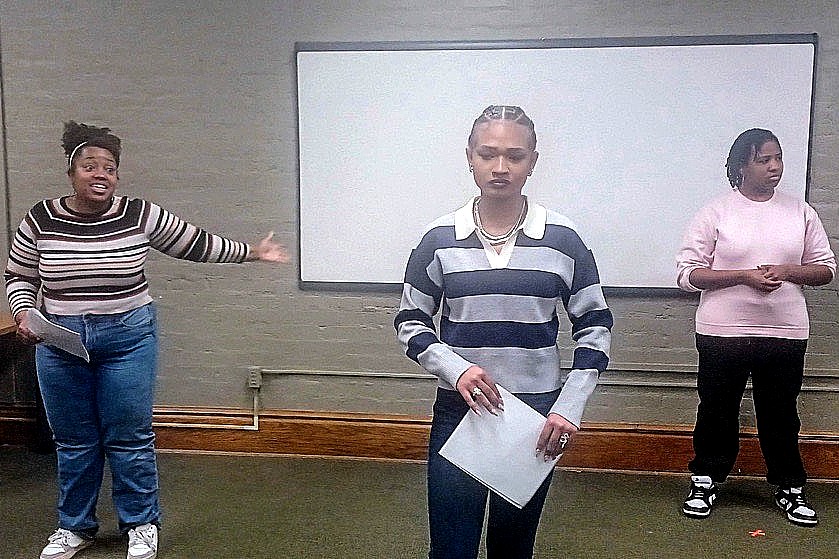
During the Community Unity Dinner performance, the three actors stood in a triangular formation and took turns speaking in different tones and portraying the African American experiences of grief, resilience, uncertainty, and hope. The piece concluded with the performers speaking in unison, reinforcing Holly’s central idea that multiple truths can coexist. The performance was met with resounding applause.
“I wanted to show that every standpoint is legitimate. Everyone has a valid perspective, and all of these perspectives are able to coexist at the same time,” Holly said. “Each of the voices portrayed in the piece are all of hope, but also of endurance and uncertainty that was present during the time and even currently.”

For Lammers, performances like this are important because they spark conversation, reflection, and learning.
“It’s powerful to sit with the notion that these words are coming from a student and can give us a window into what some students are thinking and feeling,” Lammers said. “Live performance can change the temperature in a room. It can get us out of our heads and tie really big, deep thinking with our humanity. It reminds us that there are so many ways of knowing and understanding each other and ourselves.”
The Transforming Theatre Ensemble is part of MSU’s Office for Inclusive Excellence and Impact and is known for using applied theater to spark dialogue around social justice, identity, and community issues. More information about the program is available on the Transforming Theatre Ensemble website.
By Annabelle Julien and originally published by MSU Today


