From national research ethics to global scientific freedom, Heather Douglas, Professor in the Department of Philosophy at Michigan State University, has been appointed to two high-profile committees: one at the National Academies of Sciences redefining ethical research practice for the next generation of scientists, and another at the International Science Council where she is the only American member monitoring threats to scientific freedom and assessing the state of responsible science worldwide.
Nominated by her peers, Douglas was selected to serve on an ad hoc committee of the National Academies of Sciences (NAS) charged with producing a revised, expanded, and online edition of On Being a Scientist: A Guide to the Responsible Conduct of Research, a foundational text used nationwide in the training of scientists and scholars.

For Douglas, the appointment represents both an intellectual opportunity and a natural extension of her long-standing scholarship on the ethics of science.
“On Being a Scientist is a text I have studied in my own research,” Douglas said. “It’s a really important document for training future scientists, and it’s the most downloaded publication from the National Academies of Sciences. It’s central to the culture of science in the U.S., so it’s important that we get it right.”
Within a month of the NAS appointment, Douglas also was invited to serve on the Committee for Freedom and Responsibility in Science of the International Science Council (ISC), the global umbrella organization for scientific societies. The committee responds to threats to scientific freedom and advises ISC leadership on responsibility in science, including issues concerning the requisite transparency around research funding.
“This is a great honor,” Douglas said. “I’m the only American on the committee.”
“‘On Being a Scientist‘ is a text I have studied in my own research. It’s a really important document for training future scientists, and it’s the most downloaded publication from the National Academies of Sciences. It’s central to the culture of science in the U.S., so it’s important that we get it right.”
Together, Douglas’ dual appointments to the NAS and ISC committees underscore MSU’s leadership in cross-disciplinary scholarship connecting philosophy, ethics, and public trust in science. They also build on her long engagement with the ethical dimensions of scientific practice.
Douglas joined MSU’s Department of Philosophy in 2018 and is internationally recognized for her work on the relationship between science and democracy, including the role of social and ethical values in scientific research, scientists’ responsibilities, and the science–policy interface. Her books include Science, Policy, and the Value-Free Ideal (2009) and The Rightful Place of Science: Science, Values, and Democracy (2021). A research paper written by her, Inductive Risk and Values in Science, was recognized as one of the most influential to ever be published by the Philosophy of Science journal and was selected to be included in the journal’s 90th Anniversary Collection. In 2016, she was elected a Fellow of the American Association for the Advancement of Science.
Revising Research Ethics for a Rapidly Changing World
First published in 1989, On Being a Scientist has long served as a cornerstone of research integrity and ethics education in the United States. The guide is widely used by universities, federal agencies, and scientific organizations, including the National Science Foundation and National Institutes of Health, and is frequently assigned in graduate programs across disciplines.
Douglas sees the current revision as an opportunity to help scientists think more deeply about the values that underlie responsible conduct and the societal responsibilities that accompany scientific freedom.
“It’s meant to be complementary to the kind of regulatory training that scientists get,” she said. “It’s about the ethos and the ‘why’ of doing good, responsible science.”
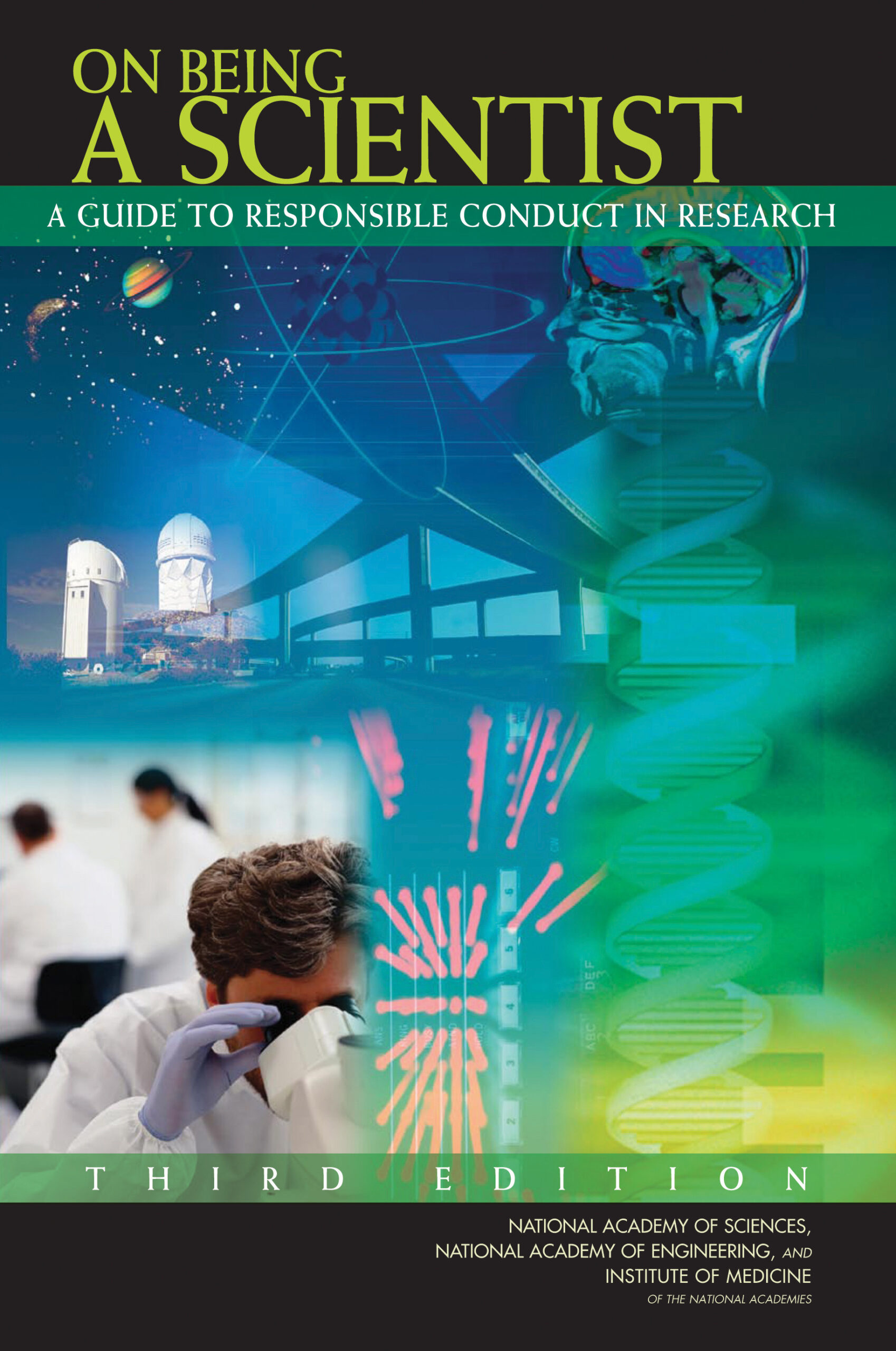
Over the course of her career, Douglas has closely studied each edition of On Being a Scientist, tracing how shifting social and scientific contexts have shaped the understanding and expectations of scientific responsibility. The original 1989 edition focused narrowly on research integrity, emphasizing the avoidance of fabrication and falsification. By 1995, the guide had expanded to include scientists’ responsibilities to communicate their findings. The 2009 revision, shaped by debates over dual-use research, gestured toward broader societal obligations without fully defining them.
Since then, Douglas said, the conversation has changed dramatically. Scientific organizations worldwide, including the World Economic Forum and the International Science Council, now emphasize that scientific freedom must be accompanied by ethical responsibility.
“There’s a lot of important freedom in science to pursue research,” Douglas said, “But that freedom only works if scientists also bear the responsibility for thinking about the impacts of their work on society. Like the Spider-Man principle — ‘with great power comes great responsibility’ — or, in the case of science, ‘with great freedom comes great responsibility.’”
Those shifts are central to the committee’s work as they aim to capture the realities of contemporary research. Beyond advances in technology and publication practices, the revised guide will address emerging issues such as open science, responsible collaboration, mentorship, and responses to inequity and harassment within the scientific community.
“The job of the committee is to revise the text so that it captures those changing dynamics of what it means to be a scientist today,” Douglas said.
A 21st-Century Guide for the Digital Age
The newest revision will be the fourth edition of the guide and will be designed for digital use with each chapter standing on its own so that they can be read independently. The four main modules of the updated version will focus on responsible conduct and stewardship of the research process, collaborating responsibly, openness and security, and earning and maintaining public trust. The committee hopes to make the revised version available by the end of 2026.
“I hope it continues to be a tremendously valuable resource for graduate students, postdocs, and scientists at all career levels. I hope it provides a framework for thinking about scientific responsibility in the 21st century, even as science continues to change.”
“I hope it continues to be a tremendously valuable resource for graduate students, postdocs, and scientists at all career levels,” Douglas said. “I hope it provides a framework for thinking about scientific responsibility in the 21st century, even as science continues to change.”
For Douglas, the work reflects both her training as a philosopher and her commitment to science as a public good. It also allows her to bring a philosophical lens to a practical document that will help shape the next generation of researchers.
“I’m a philosopher by training, which means I’m really comfortable with the normative — thinking about how things should be as opposed to describing how they are,” she said. “Everyone on the committee loves science and believes it’s a valuable human endeavor. I love thinking about science and its role in society. It’s never dull.”
By Austin Curtis and Kim Popiolek