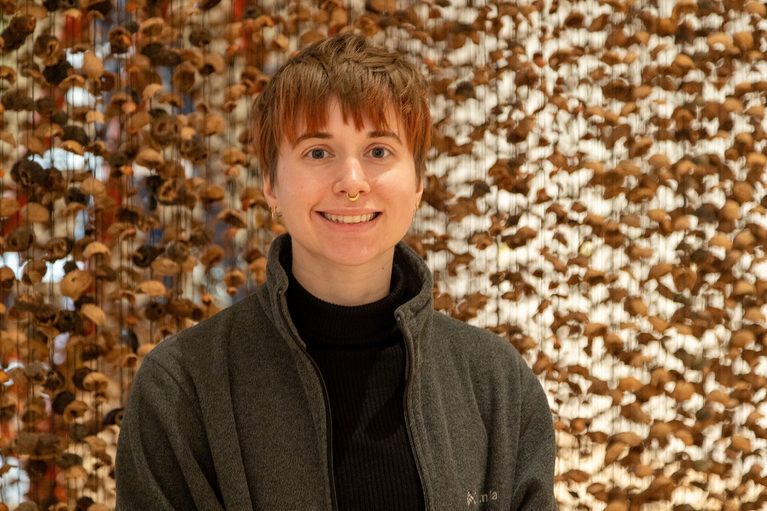
Kristen Mapes is leading Digital Humanities in Michigan State University’s College of Arts and Letters as its new Director, following a year as Interim Director. Mapes began her term on July 1, 2026, succeeding Kathleen Fitzpatrick, who served as Director of Digital Humanities from 2017 to 2024.
“Kristen has an outstanding record of leadership, advocacy, and innovation, and I am confident in her vision for the future of this interdisciplinary academic and research program,” said Thomas Stubblefield, Dean of the College of Arts and Letters. “I look forward to working with her in this role and to supporting the continued growth and success of Digital Humanities under her leadership.”

As Director of Digital Humanities (DH), Mapes provides innovative intellectual and programmatic leadership to advance and promote digital humanities activities in the College of Arts and Letters. She also teaches and advises in the undergraduate and graduate DH programs; consults on projects with faculty, librarians, and graduate students; leads workshops and community-building activities on campus; and advocates for public and open scholarship, creating pathways to digital humanities work and amplifying that work to the public.
In addition, Mapes organizes and chairs the annual Global Digital Humanities Symposium, which brings together scholars from around the world to discuss and critique digital humanities work and its impact. She also co-created and leads the Digital Culture in London and Scotland education abroad program, the only digital humanities education abroad program in the world.
“I am excited to work with the DH@MSU community in the College of Arts and Letters and across campus to grow opportunities for teaching, learning, and research in digital humanities,” Mapes said. “There is a long history of DH on campus, and I am delighted to support that legacy and foster new projects alike.”
“I am excited to work with the DH@MSU community in the College of Arts and Letters and across campus…There is a long history of DH on campus, and I am delighted to support that legacy and foster new projects alike.”
Kristen Mapes, Director of Digital Humanities
Beyond MSU, Mapes is Chair of the Executive Board of the Alliance of Digital Humanities Organizations. She has a Master of Arts in Medieval Studies from Fordham University, a Master of Library and Information Science from Rutgers University, and a Bachelor of Arts in Humanistic Studies and International Affairs from John Cabot University.
Mapes joined the College of Arts and Letters in 2014 as a Digital Humanities Specialist. She was promoted to Digital Humanities Coordinator in 2016 and Assistant Director of Digital Humanities in 2018. She then served as Associate Director of Digital Humanities during the 2024-2025 academic year before being appointed Interim Director in 2025.
Digital Humanities at Michigan State University (DH@MSU) empowers digitally engaged research and teaching in the arts and humanities. The program brings together faculty, librarians, staff, and students who collaborate across departments and colleges to build an engaged digital humanities community. It aims to position MSU as a leader, nationally and internationally, in enhancing arts and humanities research and teaching through digital methods and in engaging with digital technologies in critical and ethical ways, particularly within the context of a globally connected, public land-grant research university.
The program builds on the work being done in labs and centers across campus, as well as within curricular initiatives and efforts across a number of departments at MSU. Its curricular offerings, which emphasize experiential learning, include an undergraduate minor in Digital Studies in the Arts and Humanities, a Graduate Certificate in Digital Humanities, and a Graduate Arts Fellowship.
By Austin Curtis and Kim Popiolek