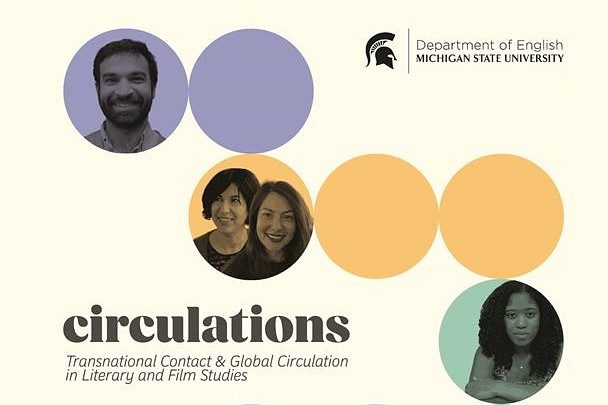
The Department of English at Michigan State University is launching a new speaker series, titled “Circulations,” which features scholars working in literary and film studies whose work centers transnational contact and global circulation.
The 2026-27 series, programmed by Professor Kristin Mahoney, is supported by the Russel B. Nye endowment, which provides funding for the Department of English to host annual speaker and lecture events. For the past few years, this endowment has allowed the department to curate a series of events around a particular theme, including the 2025-26 series “University Studies Now” and 2024-25 series “Literary Studies Now,” bringing students and faculty into contact with scholars doing innovative work to raise questions about the direction of the field and higher education more broadly.
“With ‘Circulations,’ Dr. Mahoney has curated a brilliant slate of speakers whose work illuminates the ways literature travels across borders, speaks to various global audiences, and articulates the complex legacies of nationalism, colonialism, and empire in ways that remain deeply relevant today,” said Justus Nieland, Chair of the Department of English. “We look forward to students and faculty in the broader College of Arts and Letters community engaging with the ideas of these exciting scholars.”
The new series, which highlights the research of scholars working across national boundaries, speaks to the work currently happening in the Department of English as well as across the College of Arts and Letters.
“Dr. Mahoney has curated a brilliant slate of speakers whose work illuminates the ways literature travels across borders, speaks to various global audiences, and articulates the complex legacies of nationalism, colonialism, and empire in ways that remain deeply relevant today.”
Justus Nieland, Chair of the Department of English
“These events provide opportunities for our students, who are themselves doing cutting-edge work in Caribbean studies, Black studies, South Asian studies, as well histories of anticolonial/decolonial/postcolonial thought, to engage with these scholars’ latest projects, workshop chapters in progress, and establish connections for potential future conversations and collaborations,” Mahoney said.
The Russel B. Nye endowment is named in honor of Russel B. Nye, a renowned Professor of English who taught in MSU’s Department of English from 1941 to 1979 and who helped pioneer popular culture studies in the 1960s. He was the author of a dozen books, including George Bancroft: Brahmin Rebel, which won the 1945 Pulitzer Prize for Biography or Autobiography.
The following are the Fall 2026 speakers in the “Circulations” series. Information on the Spring 2027 speakers and their talks will be released at a later date. Each of these events are open to the public and campus community. For more information, see the Circulations 2026-27 Speaker Series web page.
Nasser Mufti

- Talk Title: “Eric Williams and the Dialectics of Postcolonial Enlightenment”
- Date: Tuesday, Sept. 22
- Time: 4 p.m.
- Location: Wells Hall B342
Nasser Mufti is an Associate Professor of English at the University of Illinois Chicago. In this first talk of the Circulations series, he will read Eric Williams’s long-neglected British Historians and the West Indies (1964) as a counterpoint to the story of Victorian modernity that has been foundational to literary studies.
Written at the dawn of Trinidad and Tobago’s independence, British Historians surveys a range of Victorian historians and critics to produce a theory and history of nationalism that centers on 19th-century race-thinking and historicism. But rather than the familiar story of progress that we usually associate with Victorian culture, Williams recasts the Victorians as preoccupied with the tendency for stagnation and the regressive quality of liberal incrementalism. These Victorian lessons, he argued, were crucial for postcolonial thought and confronting the new regime of neocolonialism.
Tanya Agathocleous and Janet Neary
- Talk Title: “Misalliance: Abolition, Race-Caste Comparison, and the Rise of Afro-Asian Solidarity”
- Date: Wednesday, Oct. 21
- Time: 4 p.m.
- Location: Wells Hall B342
Co-authors Janet Neary and Tanya Agathocleous, both Professors in the Department of English at Hunter College (CUNY), will discuss their forthcoming book, Misalliance: Abolition, Race-Caste Comparison, and the Rise of Afro-Asian Solidarity, and the process of collaborating and forging connections across genre, period, and field.


Misalliance traces what they call Afro-Asian cross-referencing from the rise of abolitionism in the United States and the birth of the anti-caste movement in India in the 19th century to the early 20th century, when explicit Afro-Asian dialogues and gestures of solidarity emerged in the form of conferences and experimental periodicals. The study, divided into three parts, examines a wide range of genres — including periodicals, pamphlets, novels, poetry, essays, conference proceedings, and case law — to chart a literary history of antiracist, anti-caste, and anti-imperial organizing based in transnational comparison that spans continents and decades.
Kaneesha Parsard

- Talk Title: “Desiring Freedom: Counter-Imaginaries of Work, Sex, and Family after West Indian Emancipation”
- Date: Tuesday, Nov. 17
- Time: 4 p.m.
- Location: Wells Hall B342
Kaneesha Parsard is an Assistant Professor in the Department of English Language and Literature at the University of Chicago. This talk looks to British West Indian emancipation in 1834 and 1838 and its legacies for conflicting discourses on and philosophies of freedom.
The print culture of emancipation reveals that colonial administrators and planters envisioned freedom as a training ground by which the formerly enslaved would come to manage their own affairs through wage labor and domestic life, and indentured laborers arriving from India and China at roughly mid-century would follow suit. So, however preferable freedom was to the condition of bondage, it arrived as another kind of obligation.
Yet, the literature and visual culture of the long century after emancipation reveals counter-imaginaries by which everyday West Indians were imagined to flout the values of liberal freedom, and instead embraced freedom as desire. In conversation with philosophies of freedom from the ancients to Black and Caribbean studies, and examining literature from Harriet Martineau to V. S. Naipaul, Parsard theorizes desirous freedom as amorousness, the drive to hustle and experiment rather than produce, and the condition of reexamining the very terms of freedom.